|
Program Sponsor: PEO Ships
TPOC: Dr. Tony Ruffa, NUWC Newport
Phase II Completion Date: 4-Oct-09
Anacapa Sciences, Inc.
301 East Carrillo Street
Santa Barbara, CA, USA 93101
Phone: (805) 966-6157
www.anacapasciences.com
radick@anacapasciences.com
Dr. Robert Dick, Principal Investigator
Need
The success of the Navy's newest
series of surface warships - starting with the DDG-1000 stealth
destroyer - is heavily dependent on success in manning reduction,
as mandated by Congress. Various new automation technologies
will support personnel reduction for many types of shipboard
jobs; however, cognitively demanding jobs - such as combat
system watchstanding - have proved difficult to automate.
This is particularly the case in the operation of sensor systems,
such as those that support anti-submarine warfare (ASW). Innovative
technology is needed to reduce manning for ASW systems, while
simultaneously improving total team performance, especially
as the Navy increases its emphasis in the difficult arena
of littoral operations.
Technology Development
Previously - in the wake of
the USS Stark and USS Vincennes incidents during the run-up
to the Gulf War in the 1980's - OPNAV, Raytheon Company, and
NAVSEA funded researchers at Anacapa Sciences to solve the
very problem described above, but in electronic warfare (EW)
sensor systems. These researchers examined unusually expert
EW watchstanders who could perform much more efficiently and
effectively than their counterparts. These 'super-experts'
had developed cognitive strategies to integrate combat information
in a way that accelerated their performance of certain critical
tasks while simultaneously improving the quality of task output.
The researchers reasoned that
if all watchstanders could perform more like these super-experts,
the size of a team on watch might be reduced, while maintaining
the same level of performance or, perhaps, even improving
it.
Using a spiral build-test-build
design process, the researchers developed 'tactical user interface'
(TUI) technology that provides on-screen integration of combat
information which emulates the superior cognitive strategies
of the super-experts - to help all watchstanders accelerate
performance of critical tasks. The TUI was implemented in
a full-scale prototype, and Navy evaluators determined that
the EW watch team could be reduced 50% - from one operator
and a supervisor, to one senior operator - while maintaining
or improving quality of task performance.
In the present SBIR program,
the same researchers have extended TUI technology for application
to ASW, with initial emphasis on passive sensing. Employing
a design technology from software engineering, they extracted
the applicable 'design patterns' from the EW-oriented TUI
solution and migrated them to ASW.
|
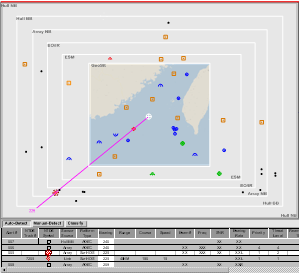
This extension of TUI technology to ASW employs 'massive
integration' of combat information from multiple shipboard
sensors and from the command-and-control (C2) system. With
enriched situation awareness for the overall tactical context,
plus tools for accelerated drill-down into specific task detail,
the watchstander can more rapidly answer six questions that
are crucial to combat sensing: Is there something there? What
is it? Where is it? How badly can it hurt me? What is it doing
now? What will it probably do next?
Technology Transition
Now at the mid-point of Year
1 in the Phase II effort, Anacapa researchers are working
closely with the Phase III transition partner - Raytheon Company
- on ensuring that Phase II product development will support
smooth transition to the target environment, the Integrated
Undersea Warfare (IUSW) system for DDG-1000.
To minimize the need for new
interface code or dedicated display surface, the TUI will
be implemented as a pop-up 'super-screen' that temporarily
overlays one of the three monitors on the IUSW workstation.
Watchstanders will launch the TUI whenever they need to quickly
enrich situation awareness and accelerate certain tasks necessary
to answer the six crucial questions above.
Programmatically, the TUI is
targeted for implementation in downstream versions of the
IUSW system via the peer-review-process (PRP) and/or engineering
change proposals (ECPs).
While not currently a Phase
II target, C2 is another viable DDG-1000 application of TUI
technology. Just as enriched situation awareness accelerates
cognitive processing in sensor watchstanders, it can achieve
similar results for C2 decision makers.
| Prior Funding for EW TUI |
|
OPNAV
Raytheon Company IR&D
PEO Theater Air Defense |
$350,000
$250,000
$1,750,000 |
| Current Funding
for ASW TUI |
|
| PEO Ships SBIR - Phases I and II |
$850,000 |
|




