| |
In our work to date, we have evaluated concepts
for approach-to-landing, hover, landing, and take-off maneuvers, and
documented the concepts with storyboard graphics and dynamic simulation
sessions. In addition, we have performed detailed reviews of information
element requirements; Army, civilian, and EMS accidents and contributing
factors; cognitive and perceptual issues pertaining to HMD and cockpit
display systems; advantages and disadvantages of existing sensor and
display technologies; the recent development of high-resolution terrain
databases via LIDAR and IFSAR processing; spatial cueing techniques
from research for the blind; and redundant, non-visual alerting methods
for warning pilots of potential obstacle strikes. Based on the lessons
learned from these reviews, we developed a list of design objectives
and a broad array of potential approaches for presenting the critical
information to the pilots in a manner that would be compatible with
their other flight and mission tasks, reducing workload, and increasing
situation awareness.
IIn-depth interviews have now been conducted with very experienced
Apache and EMS pilots to evaluate and improve the concepts, using
dozens of graphics as well as simulated flights through a detailed
terrain database. We explored the optimal appearance and behavior
of the display concepts through structured interview techniques and
discussions focused on identifying specific problems and solutions.
Our extended interviews with the expert pilots not only served to
evaluate potential solutions, but to add design objectives based on
the pilots' comments and suggestions, and to jointly converge on improved
obstacle display designs.
Continuing work involves developing and evaluating the key concepts
revealed to date and to adapt and integrate them to best serve in
Army and civilian settings, depending upon aircraft type, ancillary
equipment, type of mission, phase of the mission and other factors.
The completed ROAD system should offer enormous savings in human lives
and aircraft loss costs.
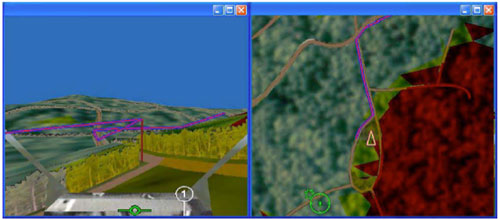 Figure title: Obstacle
avoidance highlighting of wires and terrain in forward and top views Figure title: Obstacle
avoidance highlighting of wires and terrain in forward and top views
Send
an email to Project Director Steve Rogers
|
|




